The ubiquity of the internet and mobile technologies gives entrepreneurs hope for global expansion without leaving home. Unfortunately, entering the U.S. market purely remotely still does not work in most cases. Virtual offices and emails sent from Europe rarely build trust in a country where relationships and local credibility matter more than technology itself. What truly works is a smart presence: gaining local references, entering the ecosystem, building a network of contacts, and demonstrating that the company genuinely exists, even if it does not yet have a physical office in the U.S. market and is testing it in stages.
When I look at our 1,000-square-meter facility, from which we ship over 200 types of products to every continent, it is hard for me to believe that it all started with my father’s frustration over EU bureaucracy. We are a family-owned company from Chełm, founded in 2006. It was here, in the heart of so-called “Poland B,” in the “far east” of our country, that the idea of producing radiographic phantoms was born, an idea that became the foundation of our global expansion in the medical technology (MedTech) industry.
The history of Diagnomatic (formerly Pro-Project) is a classic example of innovation driven by regulation. When Poland joined the European Union, radiology and dental clinics were required to implement strict ionizing radiation quality control standards. The German solutions available at the time were extremely expensive, almost as much as the X-ray machines themselves. My father, Henryk Kartaszyński, seeing the risk of mass closures of small practices, decided to create an alternative. He assembled the first calibration phantoms in a garage, gluing components together and testing prototypes designed to ensure patient safety in radiography and mammography.
At that time, in that garage, it seemed that the hardest part – developing the product and the technology – was already behind us. We did not yet know how wrong we were.
For the first few years, our international expansion looked like a series of successes, which lulled us into a false sense of security. In 2009, we were the only company from Poland selected for the EU “Gateway to Japan” program. We flew to Japan for a week, held a series of meetings, and quickly secured a distributor. This experience instilled in us a misleading belief that globalization is simple: you have a great product, you go to trade fairs, and you come back with a contract. If it worked in demanding Japan and across Europe, why wouldn’t it work in the U.S.?
The confrontation with the American reality was painful. For years, we tried to enter the market using methods that had worked elsewhere. We sent emails, attended trade fairs, and tried to schedule meetings as “a company from Poland.” The result? Silence. We were ignored. In 2015, we set up a virtual office in Miami, Florida, which was a step in the right direction and helped us open the market, but it still did not bring a breakthrough. Our sales were, to put it mildly, sluggish.
In hindsight, I can see that we made a mistake common to many Polish companies dreaming of U.S. dollars. I call it the “fishing across the ocean” syndrome. We were trying to sell products in the United States while remaining mentally and operationally based in Europe. We believed that a virtual address in Florida made us a U.S. company, while in reality we had no real relationships or anchoring in the local ecosystem.
It was only physical presence, a shift in mindset, and truly embedding ourselves in local structures, something we ultimately achieved not in Miami, but in Nevada, that allowed us to understand the harsh reality of this market. In the U.S., it is not enough to be present. You have to become part of the local business fabric. Without this, even the most precise MRI phantom gets lost in the noise, treated as just another “foreign” offer that is not worth attention. It took us years to understand that the message that works in Poland is completely ineffective there, and that building trust requires far more than email outreach. Today, with direct access to decision-makers and our company perceived as local, I know one thing: America cannot be conquered remotely. You have to stop casting your net across the ocean and start building it on the ground.
Without trust, there is no sales.
In 2015, we believed we had found a way into the American market. Our foothold was meant to be Miami. The choice seemed logical, even obvious to many Polish entrepreneurs. Florida was associated with direct flights from Warsaw, a large Polish community, and a gateway to the world. We set up a virtual office there. We had a prestigious address, a local phone number, and a strong belief that we had become an American company.
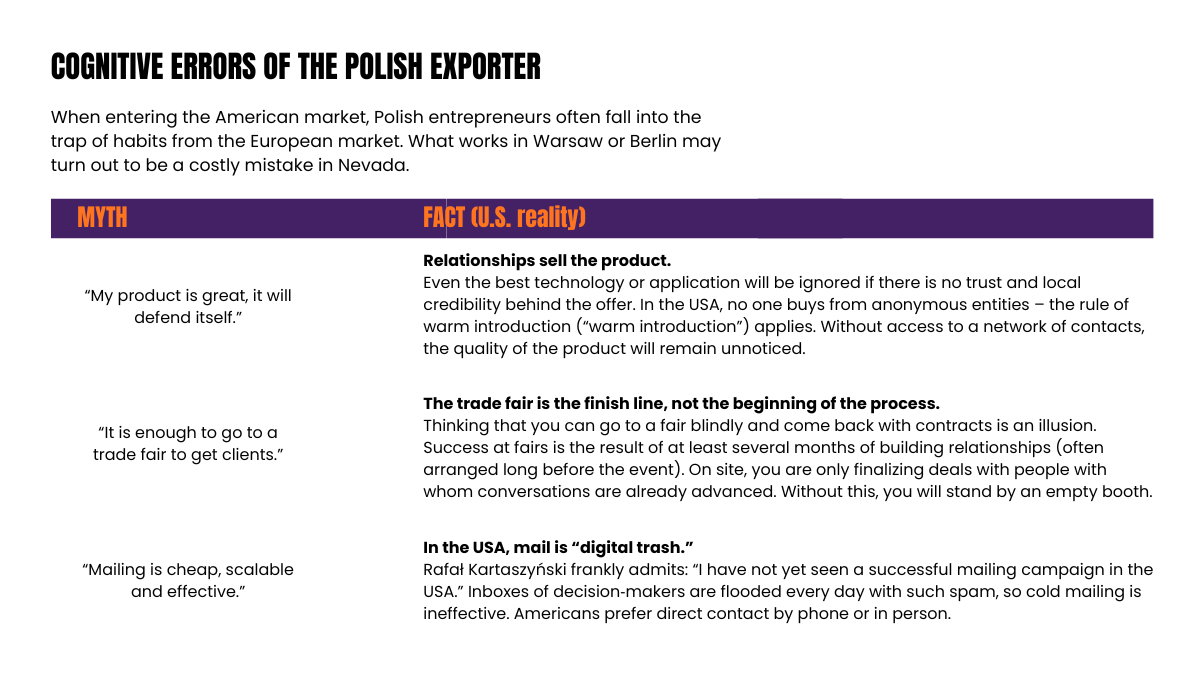
We quickly collided with reality, which I now call the “virtual façade mistake.” Our presence in Florida was illusory. Although we were formally registered in the U.S., operationally we were still based in Poland. Sales remained sluggish, organic, and without any breakthrough. We made a classic cognitive error by assuming that an American counterpart would take us seriously simply because we had an address in a sunny state. Meanwhile, in Miami we lacked what is a harder currency than the dollar in the U.S.: relationships. We knew no one, and no one knew us. We tried to “do business” remotely, assuming that technology would bridge the gap between continents (see: Cognitive Biases of the Polish Exporter).
It was at that point that I coined a term I still use when speaking with Polish entrepreneurs: “fishing across the ocean.” We were trying to catch customers in the U.S. while casting our net from an office in Poland, using tools that worked in Europe but proved ineffective there. The biggest disappointment was cold emailing. In Poland or Germany, a well-designed email campaign can still open many doors. In the United States, however, a decision-maker’s inbox is a graveyard. The sheer volume of spam and digital noise flooding American companies is so enormous that no one takes a cold offer seriously. Without a warm introduction, someone trusted making the connection for you, your email is discarded before it is even read. Americans don’t want to read about your product; they want to talk about it on the phone, and ideally shake your hand, because business there is done with people, not algorithms.
The second myth we brutally verified at the time was the belief in the magic power of trade shows. Many people in our region still think that simply renting a booth at a major event in Las Vegas or Chicago is enough to return home with a stack of contracts. That is not how it works. I have seen it many times: a Polish company goes to a trade fair, spends a fortune on logistics and exhibition space, and then its representatives stand alone, wondering why no one wants to talk to them. Why would they? For an American, a company from nowhere, without references or local presence, is a high-risk entity. Success at trade shows in the U.S. is not the beginning of the sales process, it is its culmination. You go there to shake hands with people you have already spent months building relationships with.
The Miami experience taught me that you cannot be partly in Poland and partly in the U.S. A virtual office gave us virtual results. I realized that if we wanted American decision-makers to stop ignoring us, we had to stop pretending to be present and start building real presence, based on physical availability and local trust. The American market is simply too large and too competitive to approach half-heartedly. It requires, as Americans say, commitment – full engagement.
Entering through the back door
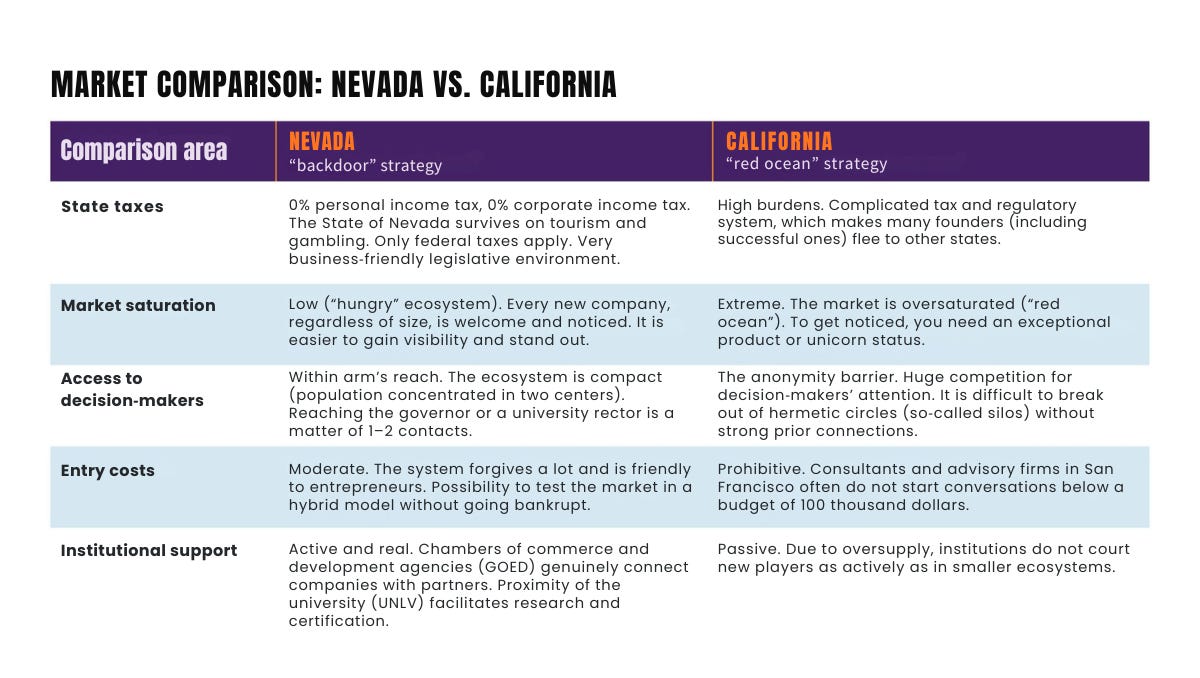
The breakthrough in my thinking came in 2019, when I joined an accelerator program that sent us to Las Vegas for a week and to Reno for another. Before that, like most entrepreneurs, I looked at the U.S. map through the lens of stereotypes: technology meant Silicon Valley, finance meant New York. Nevada, however, turned out to be a strategic discovery – what I now call the “backdoor” to the American market. I realized that pushing into California is like entering a “red ocean.” The market there is so saturated and competition so brutal that a small company from Central Europe becomes just another petitioner in line, fighting for seconds of an investor’s attention. To stand out there, you almost need to be a unicorn before you even start.
In Nevada, the dynamics were the exact opposite. A state known mainly for casinos was actively seeking economic diversification and was “hungry” for technology companies. Instead of fighting for attention, we were welcomed with open arms. It was there that I discovered the power of accessibility. Nevada’s business ecosystem is concentrated and remarkably tight-knit, an area the size of Poland, but with 90% fewer people, clustered in just a few hubs. The distance to decision-makers is virtually nonexistent. In California, reaching a university rector or hospital director would have taken years of lobbying. In Las Vegas, I realized that I was only one or two handshakes away from the governor or key opinion leaders. (See: Comparison of Markets: Nevada vs. California)
We decided to adopt a strategy I call “Deep Local.” In July 2019, after consulting with my wife, I went all in and we moved to the United States. However, it was not just about changing our physical address, but about deep integration into the local fabric. Instead of staying in a closed office, we became involved in chambers of commerce, which, unlike many of their counterparts in Poland, are powerful and highly effective organizations there. We also began a research collaboration with the University of Nevada, Las Vegas (UNLV), which gave us not only access to laboratories but, more importantly, a valuable stamp of credibility. We stopped being “guests from Poland” and became part of the local innovation ecosystem.
The effect of this transformation exceeded our expectations and proved that locality is the key to global reach. As a Polish company, we were ignored by American certification institutions. However, as a Nevada-based company with a local office and research infrastructure, we applied for accreditation from the American College of Radiology (ACR). This is the Holy Grail in our industry. We received it as the only company with European origins. This single document, impossible to obtain from an outsider position, opened the door to the largest contracts.
The financial results confirmed the validity of this shift. Thanks to physical presence and the “Deep Local” strategy, our company doubled in size in a short period of time. The United States, which had previously been a marginal market for us, became our primary customer base, generating 30% of our revenue and surpassing our home market. We proved that in the U.S. it is not the company with the best website that wins, but the one that becomes “local” within the community.
The paradox of globalization
When we decided to fully transform into an American company, my main goal was to capture the U.S. market. At the time, I did not expect that this decision would become the key to unlocking markets in completely different parts of the world. This is where the paradox of globalization comes in for us: we had to become American in order to sell more effectively in Dubai, Asia, or even… Europe.
The transition from a “Made in Poland” label to a Nevada-based company worked like a magic spell, even though the product itself remained unchanged. Polish engineering is well regarded worldwide, everyone in the industry knows we have excellent programmers and designers. However, in hard B2B business, especially in the medical sector, technology alone is not enough. Trust and brand matter. The harsh reality is that an American brand sells, while Polish origin often forces you to start building credibility from scratch. Once we began operating as a U.S. entity, with American certifications and a Las Vegas address, we were no longer seen as an Eastern European curiosity, but as a serious partner for global contract discussions.
The most tangible proof of how powerful the American flag can be as leverage came from our experience with trade diplomacy. As a Polish company, our ability to receive support in third markets was limited. As a U.S.-based company, we gained access to powerful tools of the U.S. Department of Commerce, such as the Gold Key Service. This is a program in which U.S. embassies around the world actively identify and connect potential business partners for American companies.
The mechanism is simple, but its effectiveness is striking. We pay the embassy for the service, and its staff conduct market verification – for example in the United Arab Emirates or Asian countries – and arrange meetings with potential distributors for us. Just imagine the difference in perception behind a phone call. When a salesperson from Poland calls and, with broken English, tries to get through a reception desk in Dubai, it usually ends with the call being dismissed. But when a representative of the United States Embassy calls and says: “Good morning, we represent an American company looking for a partner in your region,” the conversation is immediately elevated to board level.
This support allowed us to send our teams on trade missions to the UAE and Asia under the American umbrella. We replaced underperforming distributors with top-tier regional players simply because we had the authority of the United States behind us. This is a lesson I try to pass on to every Polish entrepreneur: America is not just a sales market. It is a launchpad. If you combine Polish engineering quality, our flexibility and work ethic, with an American brand and institutional support, you get an explosive mix that enables global scaling at a pace impossible to achieve from Europe alone. In our case, brand engineering meant understanding that to conquer the world, we needed a Polish heart – but an American passport.
Shifting the mindset
The move to Nevada and the shift to an American identity were key strategic decisions, but the hardest battle took place in my own mind. To succeed in the U.S., I had to do more than change my address, I had to unlearn the Polish way of thinking about business. The biggest cultural shock turned out not to be taxes or regulations, but the approach to risk and failure.
As an entrepreneur raised in Poland, I carried a deeply ingrained belief: failure is something to be ashamed of – a stain on your record that can derail your career. In Poland, bankruptcy or an unsuccessful project often carries a stigma. In the United States, I discovered a completely different perspective – failure is seen as a costly but valuable lesson. I met investors who openly said they would not invest in a founder who had never stumbled. To them, a “perfect” track record suggests either a lack of real risk-taking or that the first major failure is still ahead – and no one knows how that person will handle it. In the U.S., failure is a battle scar that builds credibility, while in Poland we still tend to hide such marks. Our aversion to risk acts like a handbrake – one that must be released in the American environment just to get moving.
The second habit I had to unlearn was reactivity. I once took part in research that revealed a fascinating, and somewhat sobering, truth about Polish exports: the main reason Polish companies begin selling abroad is that someone from overseas simply “shows up” and places an order. We act reactively. Poland can be a trap market, large enough to sustain a business and keep it going, which dulls ambition and delays the push toward broader expansion until a crisis forces it. In the U.S., this mindset is a dead end. The market does not wait. If you are not proactive in sales, not engaged, and not taking initiative, you disappear in the crowd. You cannot wait to be discovered, you have to go out and win the customer, often by pushing your way forward.
Finally, I had to confront something that was especially difficult for me as an engineer and an introvert – which is how I see myself: networking. In Poland, it is often reduced to exchanging business cards at conferences. In Nevada, I realized that relationships are a currency more valuable than capital. This is not small talk about the weather; it is about building deep trust, which takes months – sometimes years. Business is done through referrals. It is not enough to send an offer to a hospital director. You need to find someone who knows someone who knows that director – and can vouch for you. These “warm introductions” are key. I came to understand that in an ecosystem like Las Vegas, where everyone knows each other, being a lone wolf with a brilliant product does not work. I had to step out of my shell and start building a network of allies, because without trust, there is simply no sales in the U.S.
CEO Checklist for Success
When I look back at the journey I’ve taken – from assembling components in a garage in Chełm to managing a global company with an office in Las Vegas – I see not only business growth, but above all, my own evolution. By education, I am an IT specialist; by nature, an introvert. In Poland, within the “safe” environment of EU funding and a growing domestic market, these traits were enough. A great product could defend itself. However, America forced a radical shift. I had to step out from behind the screen and become a networker. It took time to understand that in the U.S., relationships matter more than code, and risk is not a threat – it is fuel.
That’s why, for every entrepreneur or manager who finds themselves today where I once stood in 2015 – with ambition, but also uncertainty – I have prepared a short checklist. This is not MBA textbook theory, but a set of lessons drawn from my own experience, often learned the hard way.
- Shift your mindset: stop “fishing across the ocean.”The most important lesson is this: stop being a passive exporter. In Poland, we often wait for someone from abroad to “discover” us, or we send hundreds of emails hoping one will land. In the U.S., that is a waste of time. Email campaigns run from Poland simply don’t work. You need to start building a local identity. It’s not about pretending, it’s about showing that you belong. That you have a local number people can call, and that you understand how things work on the ground. If you’re not ready to mentally switch to the U.S. market, it’s better to stay in Europe.
- Choose wisely: look for the back doors. Reject herd instinct. Everyone rushes to Silicon Valley or New York, stepping straight into a “red ocean” where competition is brutal and the cost of doing business is extreme. My advice? Look for ecosystems that are still hungry for success, places like Nevada. Here, the system is more forgiving, and access to people who can actually change your company’s trajectory, from governors to university leaders, is within reach. In smaller, more connected environments, it is far easier to earn recommendations and establish yourself as a leader than in the anonymity of California’s crowded market.
- Invest in “being present”: the hybrid model is a recipe for success. You don’t need to immediately sell your house and move your whole family to get started. But you also can’t expect that one visit to a trade fair will solve everything. Trade fairs without prior relationships are just burning through your budget. The solution is a hybrid model: invest in a hybrid and active presence (an address, membership in business chambers, local representatives) to build a foothold in the market with limited risk. It costs money – subscriptions, flights, time – but it is only a fraction of the cost of a full relocation or a single failed trade fair campaign. It allows you to test the market without going bankrupt.
- Adapt the product: your message must be local. Be prepared for the fact that a value proposition that works in Poland may be misunderstood or irrelevant in the U.S. Your message must resonate with local problems. I remember the story of a great Polish education company that failed because its app didn’t run smoothly on the iPhone, a standard that is considered non-negotiable in the U.S. Technology is one thing, but user experience and communication must be American. Without humility toward the market and a willingness to pivot, even the best Polish engineering will not survive a clash with market reality.
- Accept the facts: America is not just another country on the export map. It is a different league that requires us, Polish entrepreneurs, to let go of both our complexes and our arrogance. If you understand these rules, the “Made in Poland” label will stop being a limitation and instead become a solid foundation for global success, just as it was in our case.
In summary, I have a simple thesis that I want to emphasize: to succeed in the U.S., it is not enough to have a good product and an American address. You need to build “Deep Local”, a deep sense of local presence in which your company actually operates and is therefore perceived as a business from here, even if production and part of the team are still based in Chełm or Warsaw. Only then do you stop fishing across the ocean and start truly swimming in the same waters as your American competitors.